 12:18 PM |
  Presented by
MEDICO
Presented by
MEDICO
Medical dictionary


DOWNLOAD FREE OXFORD MEDICAL DICTIONARY
MORE THAN 20000 ENTRIES
USEFUL DURING THEORY CLASSES, CLINICS
(1.1 MB)..JAVA SOFTWERE..
DOWNLOAD AND INSTALL IT ON YOUR PHONE
MORE THAN 20000 ENTRIES
USEFUL DURING THEORY CLASSES, CLINICS
(1.1 MB)..JAVA SOFTWERE..
DOWNLOAD AND INSTALL IT ON YOUR PHONE

Sep 17, 2009
Ebola Hemorrhagic Fever
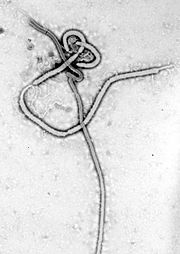
Ebola is the term for the viral genus Ebolavirus (EBOV), or for the disease Ebola hemorrhagic fever (EHF). It is named after the Ebola River, where the first recognized outbreak occurred. There are a number of species within the ebolavirus genus, which in turn have a number of specific strains or serotypes. The Zaire virus is the type species, which is also the first discovered and the most lethal.
Electron micrographs show long filaments, characteristic of the Filoviridae viral family. The virus interferes with the endothelial cells lining the interior surface of blood vessels and platelet cells. As the blood vessel walls become damaged and the platelets are unable to coagulate, patients succumb to hypovolemic shock. Ebola is transmitted primarily through bodily fluids and to a limited extent through skin and mucous membrane contact.
Transmission
- The Ebola virus is transmitted by direct contact with the blood, secretions, organs or other body fluids of infected persons.
- Burial ceremonies where mourners have direct contact with the body of the deceased person can play a significant role in the transmission of Ebola.
- The infection of human cases with Ebola virus through the handling of infected chimpanzees, gorillas, and forest antelopes -- both dead and alive -- has been documented in Côte d'Ivoire, the Republic of Congo and Gabon. The transmission of the Ebola Reston strain through the handling of cynomolgus monkeys has also been reported.
- Health care workers have frequently been infected while treating Ebola patients, through close contact without correct infection control precautions and adequate barrier nursing procedures.
Symptoms
Ebola is characterized by the sudden onset of fever, intense weakness, muscle pain, headache and sore throat. This is often followed by vomiting, diarrhoea, rash, impaired kidney and liver function, and in some cases, both internal and external bleeding. Laboratory findings show low counts of white blood cells and platelets as well as elevated liver enzymes.
Amazing Isn't it ??

Lung alveoli

Red blood cells

Split end of human hair

Tongue with taste bud

Purkinje neurons

Human hair cells

Blood clot

Villi of small intestine

Human cells with coronal cells

6 Day old human embryo
Sep 7, 2009
Mysthenia Gravis

Blepharoptosis of the left eye.

The acetylcholine receptor.
Myasthenia gravis (MG) is a chronic autoimmune disorder that results in progressive skeletal muscle weakness. Skeletal muscles are primarily muscle fibers that contain bands or striations (striated muscles) that are connected to bone. MG causes rapid fatigue (fatigability) and loss of strength upon exertion that improves after rest.
In early stages, myasthenia gravis primarily affects muscles that control eye movement (extraocular muscles) and those that control facial expression, chewing, and swallowing. If untreated, the disorder may affect muscles that control breathing (respiration), causing acute respiratory failure.
Types
Myasthenia gravis can be classified according to which skeletal muscles are affected. Within a year of onset, approximately 85–90% of patients develop generalized myasthenia gravis, which is characterized by weakness in the trunk, arms, and legs.
About 10–15% of patients have weakness only in muscles that control eye movement. This type is called ocular myasthenia gravis.
Other types of MG include congenital, which is an inherited condition caused by genetic defect, and transient neonatal, which occurs in infants born to mothers who have MG. Congenital MG
Transient neonatal MG is a temporary condition that develops in 10–20% of infants born to mothers who have MG. Transient neonatal MG is caused by circulation of the mother's antibodies through the placenta and it lasts as long as the mother's antibodies remain in the infant (usually a few weeks after birth).
Incidence and Prevalence
Myasthenia gravis affects approximately 2 out of every 100,000 people and can occur at any age. It is most common in women between the ages of 18 and 25. In men, the condition usually develops between 60 and 80 years of age.
develops at or shortly after birth and causes generalized symptoms.
Causes and Risk Factors
MG usually is caused by a malfunction of the immune system. The causative factor is unknown, but the disorder may have a genetic link. Causes include a genetic defect, which results in congenital MG, and the circulation of maternal antibodies through the placenta, which result in transient neonatal MG. Acetylcholine (ACh) is a neurotransmitter that is involved in the transfer of information to muscle tissue. In myasthenia gravis, cells that bind to other cells to neutralize or destroy them (called antibodies) destroy acetylcholine receptor sites (AChR) in areas of muscle tissue that receive nerve impulses (called neuromuscular junctions), preventing nerve impulses from reaching the muscles. This results in weakness and rapid fatigue in affected muscles.
MG may be associated with other autoimmune diseases. Patients with family members who suffer from disorders such as rheumatoid arthritis, scleroderma, and lupus may have an increased risk for myasthenia gravis.
The thymus is an organ that produces cells involved in immune responses. It is located below the larynx and above the heart. Approximately 15% of MG patients have a tumor of the thymus (thymoma) and 60–80% have abnormal enlargement (hyperplasia) of the thymus.
Subscribe to:
Posts (Atom)